Upside-Down Hanging Pot

I made my first Instructable! It can be found here. I think this blog will likely disappear before Instructable does, but I hate when I find a blog, want to see the project and the link is broken, so I will endeavor to paste the Instructable here.

It seems to have worked very well! Here it is in its entirety as of now.
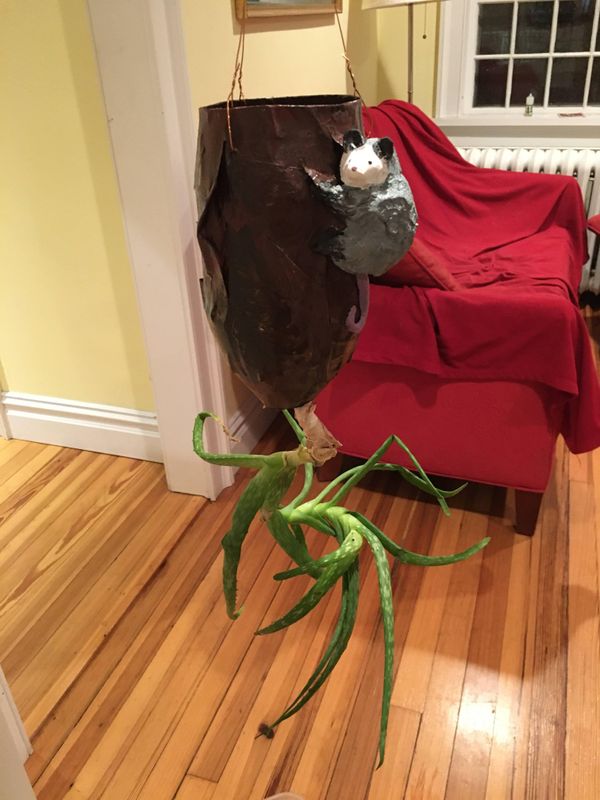
Upside-down Hanging Pot With Things You (May) Have in Your House

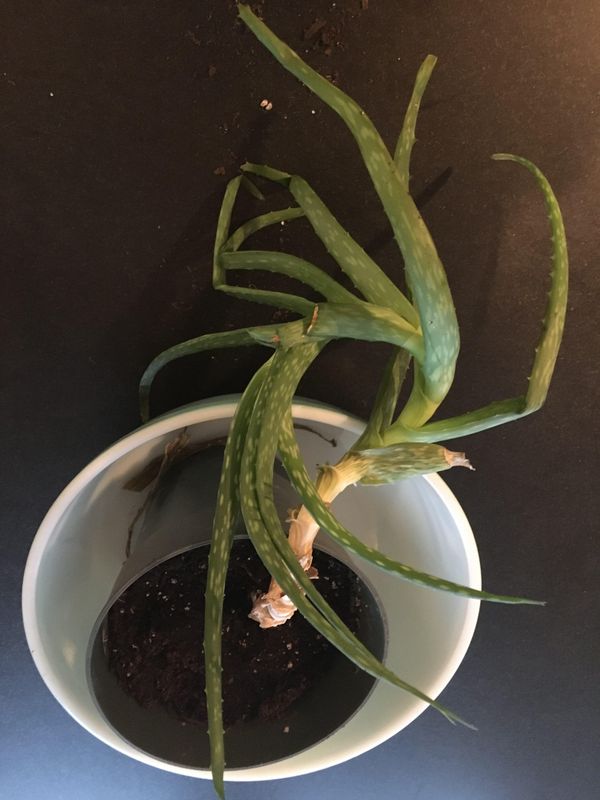
Someone gave me a free aloe that had been growing at the edge of a pot. It didn’t have the root mass to hold itself up or to dangle over the edge of a pot like it had been, so I decided to try growing it upside down. Aloes apparently do OK like this although they often still try to grow up. Hopefully mine will continue to spiral like it has been!

I didn’t want to buy an upside-down pot so I decided to make one. This project was very much experimental so I didn’t spend too much time on any one step. I’ve thought of some refinements, which I’ll discuss.

I made this project with the things I had available. It’s pretty flexible and forgiving. Where I’ve thought of substitutes, I’ve included them.

Supplies:

To make this roughly how I made it, you will need:

  • A plastic bottle, or another waterproof container that you can easily cut
  • Newspaper
  • White glue (or ingredients for another paper mache recipe)
  • Drywall joint compound (or spackle, or ingredients for paper mache clay)
  • Paint — I used acryclics
  • Tinfoil
  • A plastic take-out lid (or
  • Wire or string for hanging

Tools:

  • Scissors
  • Something to put a hole in plastic (I used a heated nail)
  • Paintbrushes

Step 1: Cut Bottle

Cut Bottle
Cut Bottle

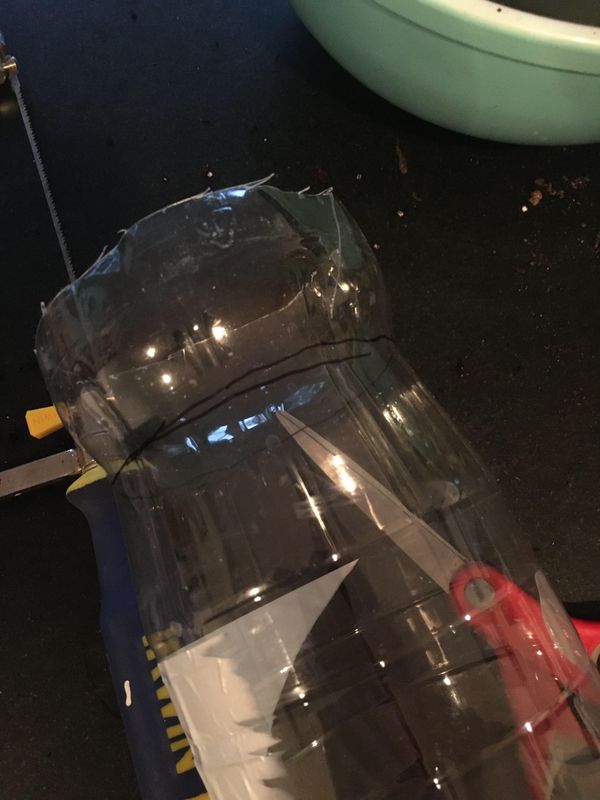
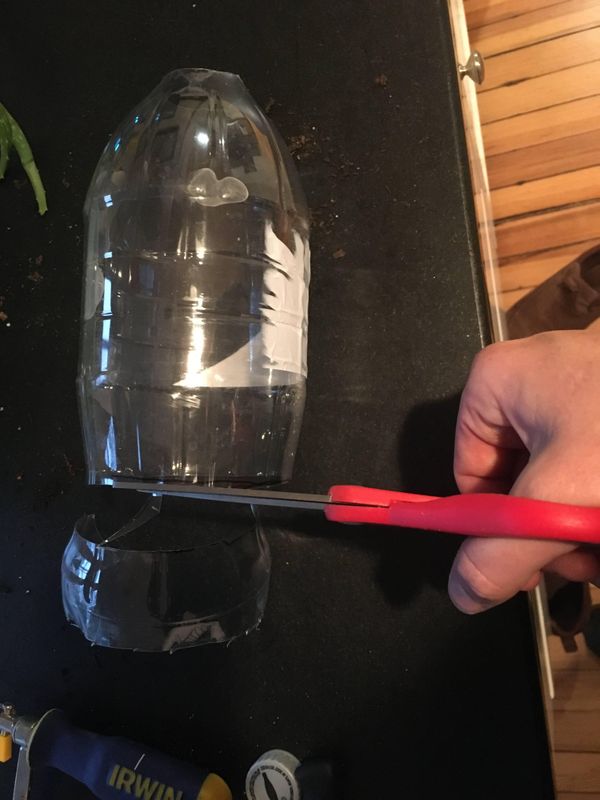
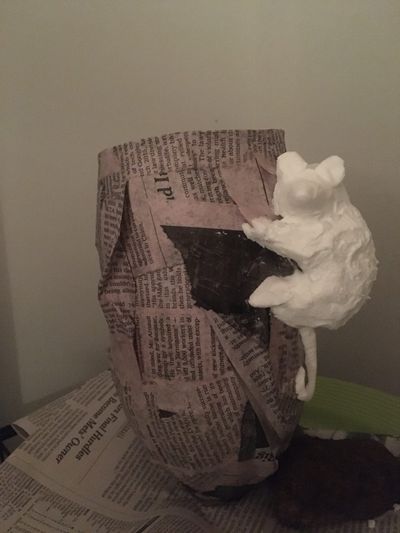
Unlike many paper-mache armatures, the plastic bottle will remain in place and form the structural core of the pot. So cut it to a shape you can live with. I had used this 2L bottle as a cloche this spring, but it’s too narrow to do a good job for that, so I repurposed it for this. I cut off the bottle neck so I could fit the roots through and marked and cut the base to get a shape I liked.

Two notes here: when cutting (especially the wider base) take note of the direction you’re cutting. One side of the cut will tend to have sharper edges and little “splinters” of plastic. Make sure that’s the side that’s coming off. For these right-handed scissors, the correct way to cut was as shown in the photo.

Also: It turned out that I could have still fit the roots through with less of an opening in the neck, and it might have been easier or it might have been harder to get the plant to stick. The issue is that if the hole is smaller, you need less support around the stem, but you also can’t fit any fingers in the neck hole to finagle things. (You can still stick your hand in from the other end, of course.) If I had left the bottle neck, I think a donut of tinfoil might have been enough to stick the aloe in securely, but I don’t know. With a hole this size, the solution was more complicated than that — more on it later.

Step 2: Make Holes
Make Holes

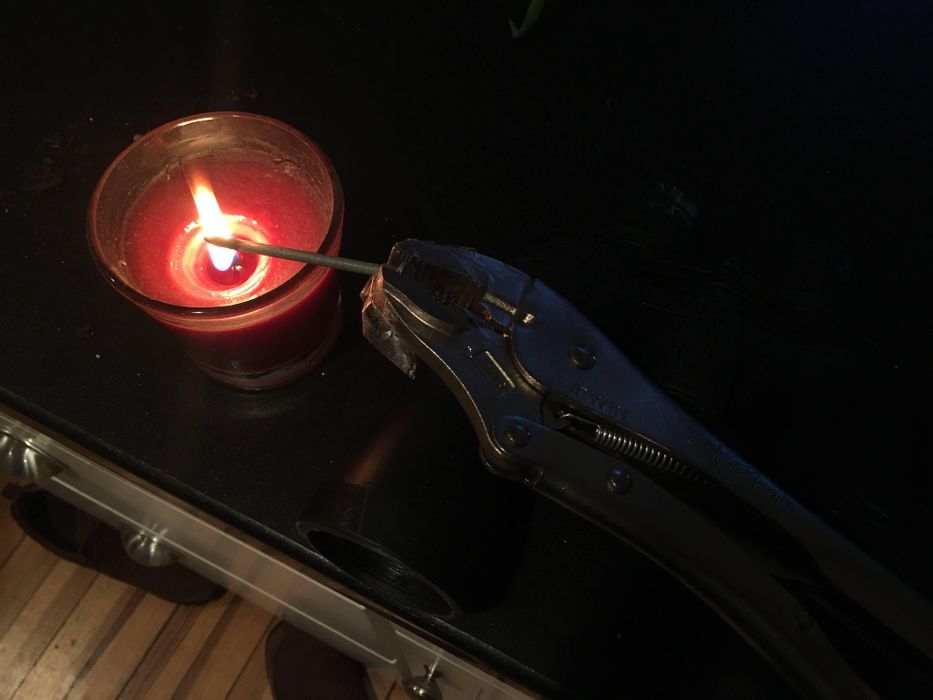
I made three holes about an inch from the new top of the pot. Four would also be good. For me, the easiest way to make them was to grab a candle and a nail, as shown. The nail doesn’t have to be very hot to make a hole in thin plastic! Drill bits tend to catch in plastic and tear out, but that could also work.

Step 3: Cover Plastic in One Layer of Paper Mache
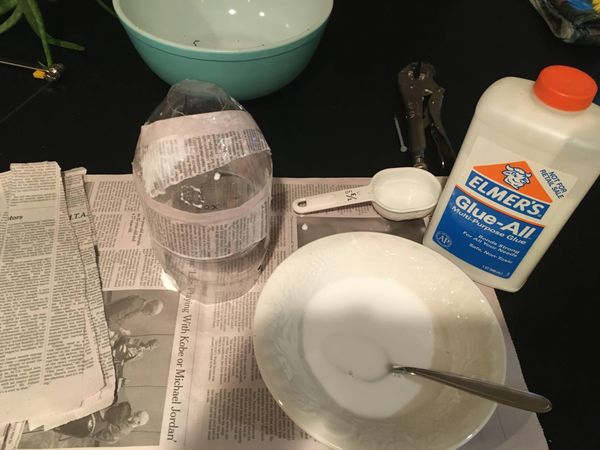
Cover Plastic in One Layer of Paper Mache
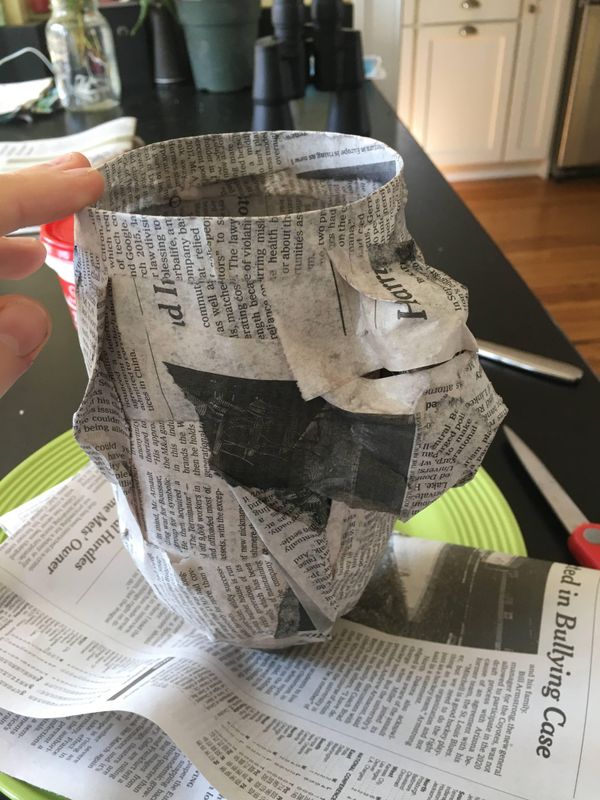

Start by envisioning what you want your pot to look like. I used just one layer of paper mache plus some sculpture on one part. I think it could be nice to build it up more and make it look like terracotta. The easiest way to do that would probably be drywall joint compound or paper mache clay, but I suppose it could be done with newspaper as well, or newspaper could be used for bulk with joint compound on top for the smooth texture.

I made paper mache mixture the easiest way possible: by diluting Elmer’s glue. Go for a ratio of 2 parts glue to 1 part water, or as thin as half and half. I chose this because it was easy, less susceptible to mold than some recipes, and I really didn’t need a lot — I used a third of a cup of each and I had way too much. (You can store this; it keeps at room temperature for a long time, possibly indefinitely, I’m not sure). However, if your design calls for more layers, it may be worth it to use one of the cheaper recipes available. Ultimatepapermache.com is my go-to source for paper mache advice and recipes. (No affiliation.)

Anyway, dip the newspaper strips in your mixture and apply straight to the plastic. For the sculpture armature, I just balled up tinfoil and stuck it to the side with newspaper strips. I also twisted strips and used them to make a “bark” texture.

Step 4: Clay
Clay
Clay
Clay

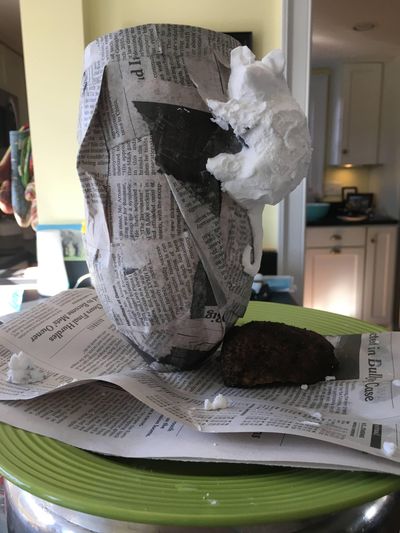
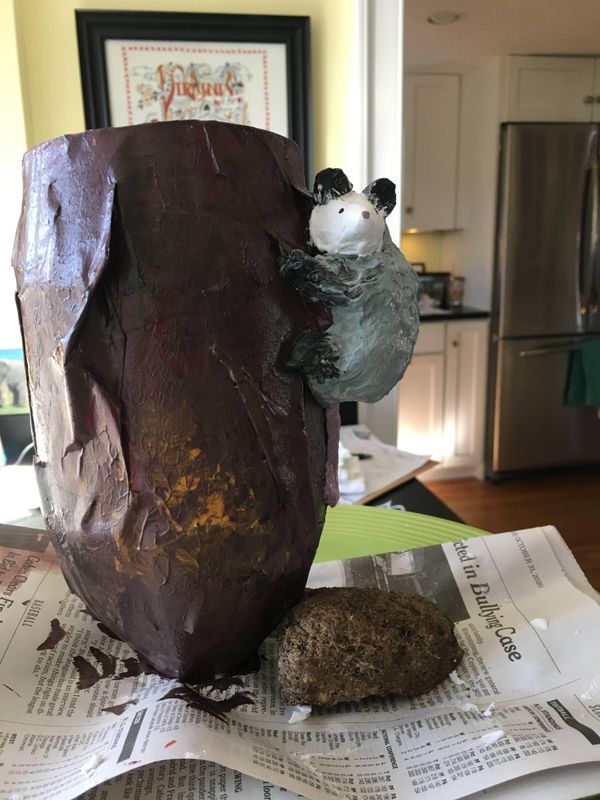
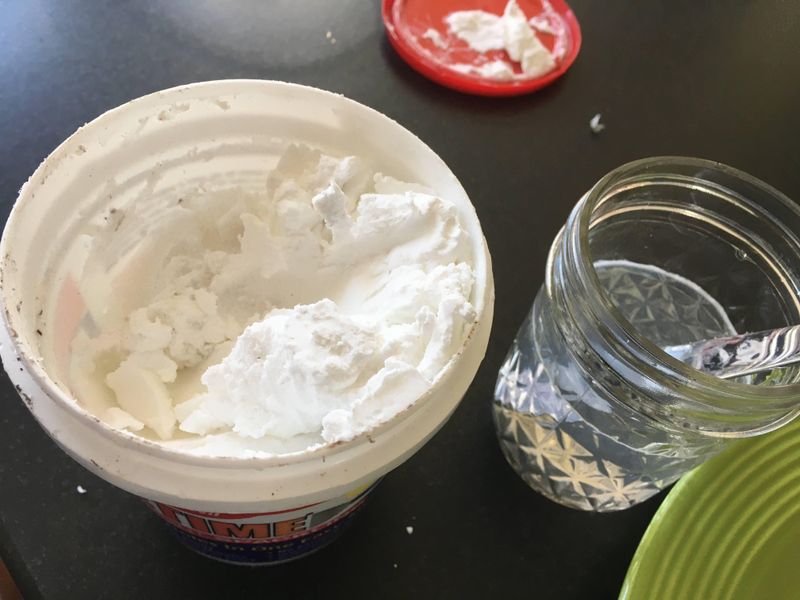
I knew I wanted more sculptural detail than I could get with newspaper, and there are several ways to achieve this. Ultimate Paper Mache has a recipe for paper mache clay that I’ve used in the past that dries very hard and strong. She says you can also use drywall joint compound (any brand except DAP) as a sculpting material. It’s strong and smooth, it’s just more expensive. However, I didn’t have any joint compound, and it’s also an ingredient in paper mache clay, and I didn’t feel like making clay anyway, so I decided to try spackle. Please use caution if you try spackle! In general, it is apparently more prone to cracking than joint compound and it’s also not as strong. It’s also not that easy to sculpt with because it wants to stick to your fingers.

The spackle I had is lightweight spackle and specifically advertised on the tub that it does not crack. I think it’s a pretty different animal than normal spackle. Again, it’s probably worth getting joint compound instead, but it worked out for me, with no cracks, and it held up well to painting. Since the plant itself is fairly delicate, I’m not too worried about the weakness of the spackle.

The third photo is the dried spackle. I just let it dry overnight. It was probably ready sooner, if you’re in a hurry — consult your tub or recipe.

Step 5: Paint!
Paint!
Paint!

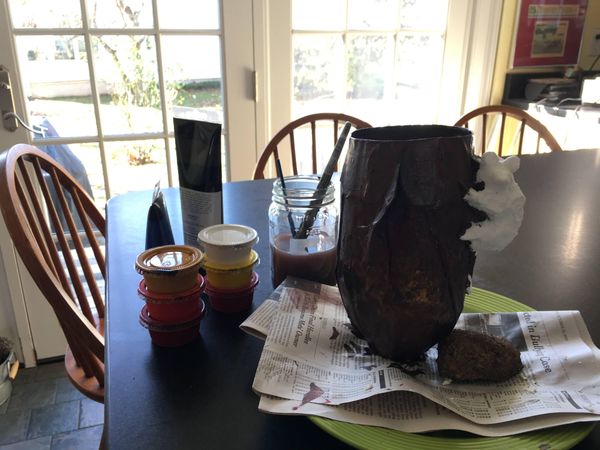
I used acrylics. They are forgiving and widely available. I allowed plenty of time for each coat to dry. I haven’t done a lot of 3D acrylic painting, and one thing I would do differently is not bother not to run over the margins on the bottom coat. You can see that I was pretty exact with the brown edges, and it only annoyed me later when I found a couple of small unpainted spots on the bark next to the possum and had to touch it up. Go over the edges freely if you’re using acrylic. Even white paint will cover up dark paint in one coat.

If you do need to do corner touch-ups, I had good luck with them by getting a small amount of relatively dry paint only one side of a small flat paintbrush and using that to paint the correct side without getting paint on the other side.

By the way, I was happy with this color when painting, but in a room, it’s pretty dark. Consider lighter, more neutral colors since this is home decor, unless you’re specifically going for a dark look.

Step 6: Wrangle Plant
Wrangle Plant
Wrangle Plant
Wrangle Plant

I don’t have great pictures of this step because I needed both hands the entire time. This is potentially the most complicated step and worth planning out in advance.

My first idea was to take a bottle identical to my base bottle and use that as a plant holder, but I hated the way the naked plastic bottle neck looked sticking out of the bottom of the pot. My second idea was a donut of tinfoil cinched tight around the woody stem, which sort of worked, but didn’t really seem secure enough due to the size of the hole. Another tutorial online recommended part of an AC filter. That seems like a good idea but I did not have any handy so I can’t vouch for it.

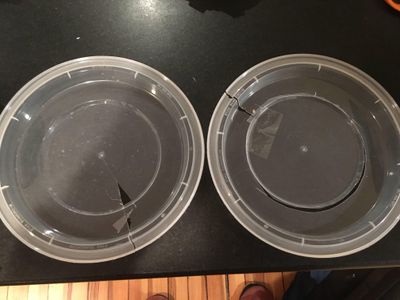
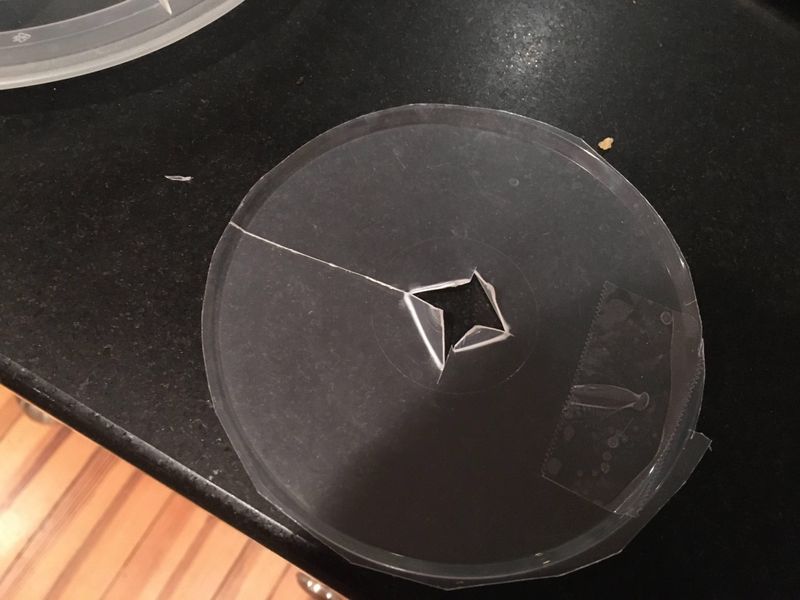
I was Facetiming my mom while doing this and she suggested trying to cut a hole in a tupperware lid. I ended up cutting one to look somewhat like a soda lid, as shown in the picture. The cut on the side is important because it makes the size adjustable. Note that with the type of plastic I used (a cheap takeout lid), trying to cut it too enthusiastically cracked the whole thing. This type of plastic still works! I just cut more gently the second time and used a piece of packing tape as a ripstop. You can see the contrasting cuts.

I did use a bit of foil, too, to brace the steam against the bottom hole in the pot, prevent rubbing, and make the whole thing more secure. The exact method will depend on your plant and your pot. If it has a big strong root system and a narrow crown, and you use a plastic lid, I recommend cutting the inner hole slightly differently — try to make it more of a true circle so the pointy tabs don’t injure the crown or stem of the plant. In my case, they grip the stem and I think they help keep the aloe situated, so I left them on.

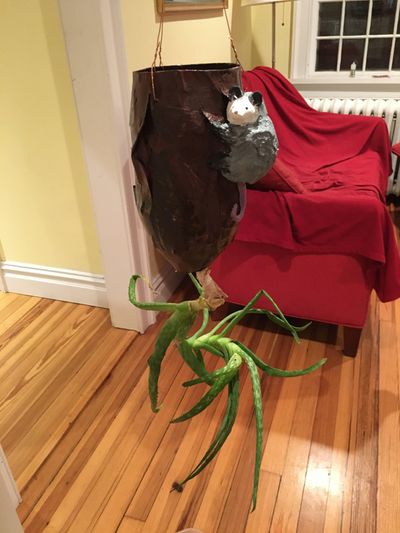
I added dirt, watered sparingly and hung the plant using some copper wire. It’s been a few days and the aloe hasn’t died yet, so so far I can call this a success!

Step 7: Variations

As I mentioned, I think a sleeker terracotta-like look would be pretty cool. Mine ended up looking very much like paper mache and acrylic. For this version, I was fine with that! I was in a hurry to pot the aloe more securely because it kept falling out of its regular pot, and I wasn’t sure how it would all fit together. If I ever do another one featuring a more sculpted look, I will upload pictures here. Meanwhile, I hope you use these basic steps to make and enjoy your own upside-down hanging pots!

Processing fleece: how old is too old?

I currently own one fleece. I bought it for a good price four or five years ago, and then I stored it, unwashed, in a paper sheep food bag in my garage. Yep. I’m not proud of it, but that’s how it worked out. I did think about using the whole thing as mulch and starting over with a nice new fleece that wasn’t actually coming apart on me, but this is the fleece I have and I felt terrible wasting it. Besides, I plan to use it for wet felting so staple length isn’t as important, I like a sort of messy look so I’m not too worried about neps and their ilk, and all in all I just decided to try.

I had intended to eventually use the suint method on it, but when I pulled it out of the bag it had moth eggs on it. It didn’t when I checked on it last year, but there you are. I almost mulched it again but after some research I was pretty confident that I could hold the temperature of the wash bath hot enough for long enough to kill the eggs and larvae. I did toss the worst of the wool near the top and used it to mulch my baby apple tree, and then I started in on the rest.

I wasn’t sure if the fleece had been skirted or not (again: I own one fleece) and the dirt that was caked in was really caked in, so off went some more to the mulch ring, and I pulled dirt out of a lot of locks by hand. I used this method by Ten Good Sheep, except that our damn washing machine cannot be filled and used as a soak tub (don’t get me started), so instead, after rinsing each half of the fleece three times in the washtub outside (and using all the delicious rinsewater for my baby trees and shrubs), I used our kitchen sink instead. Here is my outside setup, using my dad’s dirt screen:

This is after a rinse or two, don’t remember now:

Then I did two washes and two rinses in the sink and I did truck it up to the washer to drain and spin it. It did not get completely clean. I guess that’s what happens if you rinse a fleece after four years. However, it smells clean and lovely and there’s just a few locks with stuck-together brown ends. I wonder if the suint method would have helped with those, but the moths were obviously a higher priority, and I wasn’t sure if they’d drown in the bath. I used my Unicorn Scour for the washes and white vinegar to rinse.

I didn’t own anything to card with, so faced with a choice between $50-60 hand cards and a $300-400 carding drum, I went with the drum. I bought it on Craigslist from someone up near Hartford and she even brought it down for me! So far it feels worth every penny. I am constantly looking for something to do on the phone that’s productive, but not distracting. Carding is perfect. It takes maybe 15% of my attention — the ideal amount. Some of the wool comes apart if I tug it but most of it is strong, clean and beautiful. I haven’t seen any moth sign … but I’m keeping it away from my cashmere sweater just in case. One nice thing about owning one fleece is that I have no stash to ruin. If I possibly can I’ll stick to one fleece at a time so I’m handling it often and not allowing darkness and stillness to attract those hungry woolmoths. Please remind me I said this when the fiber fairs reopen next year …

The Music That Will Bring Me Back Here

This summer has been a lucky one, as far as music goes. Three of my favorite artists have dropped new albums, and they all have their share of genius. In May, Mary Lambert released Bold, a rock-band follow-up to her brilliant debut. Jason Isbell released The Nashville Sound in June, but I was busy, and I’m just now listening to many of the most tender and introspective tracks. Josh Ritter just last week released Gathering, a slower-paced, more reflective offering than 2015’s Sermon on the Rocks.

These are the songs that will bring me back to my Baltimore summer, this hazy, humid interstice during which I am both lonely and not lonely, employed but rarely accountable for how I spend my time, living in community and in a tiny bubble of my own. I’m learning important things about how to be a person, and this music is both a lens and a mirror-frame for that long, tiresome, necessary process. Of course, it’s not just the latest releases that I’m listening to. I have very little music on my phone, which has the unintended, but happy, consequence of helping shape a pretty coherent soundtrack for the summer. Here’s what I listen to while bouncing joyfully over potholes and revving up hills while my heart leaps ahead:

  • Secrets, Mary Lambert, good for late-night drives and early-morning bike rides, both
  • The Essential Mary Chapin Carpenter — although it also brings me back to my bike trip over the Smokies with Eric, which may remain my best and only bike vacation forever
  • The Oh Hellos’ self-titled EP
  • Hozier’s self-titled hit album
  • Southeastern by Jason Isbell, which has accompanied the entire ridiculous peregrination from my last days in Burlington to here

But in the kitchen, it’s Lori McKenna, the Weepies, Angel Haze and the three new albums. I’ve also been listening to Clipping, who I first heard a few weeks ago, like every other This American Life fan in the country. I’m in the kitchen a lot, but it’s not that I’m cooking again; I very rarely cook right now, for a host of reasons, only some of which I know. But I do wash the dishes, clean the fridge, and perform a variety of other tasks that I have come to realize are spiritual in nature — at least for me, this wayward flower child so often enraged by the senselessness of civilized life. I have been neglecting these spiritual duties, so it’s no wonder I’ve been feeling adrift. Composting is hard in the city of rats. Cleaning is hard in a collective house where only a few of us seem to care. It’s easier to let it go, be satisfied feeding myself, put the recycling in the bin and call it a day, but it’s been eroding my purposefulness over time.

I realized this all of a sudden a couple of days ago when I found myself fighting back tears while trying to explain to Matt why I don’t make jam right now. I didn’t actually know why I don’t make jam right now, and I don’t know now, but I do know that not being in the kitchen deprives me of a pretty essential part of life that I call religious in my head and self-correct to spiritual. It’s something about the combination of ritual, satisfaction, and necessity. I came back to my collective armed with a little bit more knowledge about who I am and what I need, and I cleaned our fairly disgusting fridge and sorted everything into humans, hens, rabbits, and compost. No trash. ❤

Thinking Ahead

I’ve decided I need to start writing more because someday I may wish to write my memoirs. One of the perks of belonging to a relatively rare identity category is that it gives me a pretty good sales angle on any memoir I actually write. Obviously, some of the necessary recording is going to have to be private, but some of it can meanwhile do double-duty as a life update. For the curious: Baltimore is fine. I’ve been feeling a little gray around the edges. I’m not cut out to work on contract full time, and that may be my primary problem. The perks of being a flex-hours contractor are considerable — I’ve visited the intentional community I belong to four times this summer, which is kind of a big deal considering it’s 430 miles away; Matt and I get as much time together as we want; I can go to meetings any time of day, step up to say “I’ve got that” when something needs done, and take full advantage of the weather, whatever it is.

But they’re not outweighing the difficulty of making my own schedule all day every day. So I’m applying for in-person jobs again. Some of them are exciting! One at the aquarium introducing critters to visitors — I feel like that’s a legit “all my experience has been leading to this job” job, but it’s only ~14 hours a week, so I’d be keeping those side-gigs strong, too. One at a call center “telling people about benefits they already have and don’t use” — possibly a scam, but promising-sounding. And one as a lab tech — which, yes, is a very exciting opportunity. Go ahead and mail me a hat, but I’m not eating the whole thing unless I go to grad school.

Anyway, I’m super excited about all three. I was also excited about a book warehouse job, but it’s in Halethorpe, which is just too far away. I still don’t know what I want to do (until/in addition to the draft horse dream). Is that famous lawyer glut over yet? No? Well, I’ll be over here with the horseshoe crabs.

In other career-related news, Act 166 is causing a shortage of qualified early childhood teachers in Vermont, and some truly excellent centers are running below capacity because they can’t find anyone who’s certified. This is what you get when you value education over experience, y’all. (Here’s the Cliff’s Notes: the VT legislature recently approved Act 166, which is pretty cool because it provides funding for 350 hours/year for kids 3-5 to go to preschool, but the rating system it’s based on now devalues one of the traditional education+experience certification combos in favor of more stringent education-only, experience-disregarded combos.) This is part of the broad and malicious pattern of shunting training costs onto students, and in this case, as in some others, it also hurts the industry. Nice double whammy there.

Anyway, unlike the creeping pattern of shifting training burdens, Act 166 has nothing to do with me personally … unless I decide to chase down one of my fantasies and go back to Williston to reapply for the best job I’ve ever had. Nobody hold any breaths, okay? First of all, I couldn’t move back to Burlington yet even if I wanted to — too little time has passed. And with a whole classroom shut down at the Center, I doubt there’s room for an assistant teacher with no desire to be certified in early ed. More importantly than either of those: there’s so much more to explore!

I don’t know, though. I do think pretty regularly about becoming a teacher. To be clear, I also think regularly about becoming a floor nurse, a nurse practitioner, a cabinet maker, an electrician, a lab tech, and whatever I had to have 2 years of experience being to qualify for the job posting I’m reading at the moment. So don’t get too stamp-happy with that hat-mailing, okay?

March

So, blogging is a thing I should get back to. I’m not sure what my schedule will be yet because I don’t have a strong life routine. Usually I structure my life around work, but I’m a freelance editor now, which doesn’t provide structure. So far I’ve been getting a few hours of work every day or two, and when I get work I have around two days to complete it, so I can make any schedule I want. I was a bit trepidatious about the arrangement since I am not great with time. But so far it’s been about perfect. My general method is to do the work as soon as possible after I get it, leaving me free to gallivant until my next assignment comes in. But if I already have a full day planned, I can block out the next day for working. If by chance I have two full days planned, the evening and interstitial time is generally enough. I can usually turn down assignments, too. Right now I’m accepting everything that comes, and I’m hoping to get more assignments as time goes on; what I’m getting now will pay the bills, but not much more.

So what makes a full day? It depends. My other work – unpaid – is at the Free Farm, where I help out with the garden and various food rescue projects. So I’ll spend a few hours there when there’s something going on. I’m moving in there April 1st, which will mean it’s much easier to work and be involved, but right now that’s just a few hours a week. I also spend a lot of time dating and making friends and even more with the friends I’ve made so far. I spend a little bit of time going to trainings, talks and classes. I like that I’m flexible. I could definitely get used to this. If only Bernie Sanders had been elected president, I could happily do this for a long, long time. As it is, I’ll lose health insurance sometime in the next 14 months. Maaaaybe by then I’ll have enough editing experience to get a job with benefits. Anyway, I meant this to be a Big Update, not just a note about work, but I got busy so I’ll go ahead and upload it how it is and keep working on that Big Update for later.

The Very First Tomato

A few months ago I promised to write down some of the moralizing stories I tell the Lions. Most of them I’ll probably post in short form, but here’s one I wrote in long-form during nap.

My great-great-great-great grandfather was a farmer in the old country, and as well as growing grain and fruit and tending his forest, he kept a beautiful garden. One day in late June he went out looking for his first tomato to bring home as a surprise for his wife. He had seen it just the day before – plump, juicy and almost red enough to pick. But when he got to the vine it had been growing on, it was nowhere to be seen! My great-great-great-great grandfather’s eyes narrowed. Yesterday he had seen Mrs. Nork passing by, and she just would have stopped and plucked a tomato before going on her way. He marched over to her house.
“Mrs. Nork,” he said when she invited him in, “Did you by any chance invite yourself to a tomato from my garden yesterday?”
            “Why, no,” she said, surprised. “We have a few coming in ourselves. Not as early as yours, but soon enough!” My great-great-great-great grandfather harrumphed suspiciously, but he had no choice but to believe her, so off he went to visit Mrs. Guten, who often passed his garden on her way home from work. He knew she had no tomatoes in her garden. Maybe she had been tempted.
            “Excuse me,” he said when Mrs. Guten hallooed from her asparagus bed, “have you by any chance helped yourself to a tomato from my garden?”
            “Why, no,” she said. “Tessa hates tomatoes. They turn her stomach. But I still have some very fine lettuce; would you like some?”
            “Oh, no thank you,” said my great-great-great-great grandfather, a little bit ashamed. It was getting on towards noon, so he stopped to water the seedlings and headed inside for lunch.
            My great-great-great-great grandmother had made soup and salad. On top of the salad was a bright red tomato. “Look, darling,” she said to her husband. “I went down to the garden this morning, and the first tomato was just perfect!”
            My great-great-great-great grandfather laughed and put his head in his hands. When he was done laughing he put together a big basket of vegetables to leave on Mrs. Nork’s porch: baby corn, late peas, lettuce, and the second tomato – and not a single zucchini. For the Mrs. Gutens he made their favorite almond cookies. He left them on the porches with no explanation, so they could have a little mystery of their own.

Islands

I have been doing the work of finding islands of peace pretty steadily for about six days now.* It’s going swimmingly — and by that I mean that I am usually far from shore. But my use of the word is not entirely sardonic; it’s going as well as can be expected; I can now keep in mind almost all the time that such islands exist, and I can find them on my own. I have never had to do this before: a text to my best friend (no need for response) was the fastest way to an island and, by mutual agreement, I used that method of transportation more often than any other. For some reason I didn’t have the same trouble then that I am having now, which is that staying on an island of acceptance is very difficult work. Well, I will have lots of practice! I am feeling pretty good just now and my “hooray” is not at all facetious.

*This is the work I have been doing for years, but this fall I took a break from it. I’m starting again by dint of circumstance.

The work of finding balance of expression is not going as well! You can see by the paragraph above that I am currently in the mood for indiscretion. And even in real life I am frequently snarkier than I intend, which is grossly unfair, as the range of snark I can stand from Wafflets is extremely limited. I’ll figure that out, though.

I remember feeling unsure last week about the work that I need to do right now — whether I should cut and run to go back to farm work, or just go be a Catholic Worker already or what. But I am doing considerable work, in three parts. First and foremost, my work is to love my students, keep them safe, and teach them to love others and themselves. Second, I am still, in a limited way, practicing my food-production and homemaking skills. And third, I am learning how to love freely, independently, and fully, without tearing myself apart. (I cannot yet love politely. Sorry, Wafflets. That’s work for later. I am trying not to be too hurtful, or thoughtless, or actively rude, but it’s a lot.) The work I’m doing now feels like work worth doing.

In other news: most of the remaining tomato seedlings do appear likely to Make It at least until it’s time to plant them out (I literally just knocked on our coffee table, just in case). The mushroom table looks positively Pinterest-worthy. The compost bin is still not done but I bought the drill bits I needed and theoretically I can do it whenever it quits raining. I cooked dinner maybe once this week so I’m looking forward to more cooking next week.

The lilac is blooming, the bleeding hearts are glorious, and I finally got all the way through the process of harvesting and processing knotweed shoots (it’s not even that long, but the season’s so short!) to taste the spectacularly mediocre sweet puree recommended by City Herbal. (Maybe next year I’ll try a different recipe.) The garlic mustard is flowering already. So is our neighbor’s Giant Solomon’s Seal, a personal favorite of mine. (I mean to look at. It’s edible, but not responsible to eat.) I found a patch of nettle last week and though not terribly convenient it’s certainly in a place I can return to, so this week or next the Waffle will be enjoying nettle quiche. Or something. There’s very little that nettle isn’t good in.

I wonder if the milkweed is sprouting? The pokeweed almost certainly is, but I haven’t seen any skeletons whatsoever, and I don’t imagine I’ll find any until late summer when it’s much more visible. Well, if I’m here next May I’ll know where to find them. (I see why I used to speak with such certainty; I see why I bought the loom. It would be so lovely to think about next May and know I’d be here. Maybe it’s enough to enjoy this May. I’m doing my best.)